“Fight the good fight, holding on to faith and a good conscience” (1 Tim 1:18-19)
A Cannonball That God Turned into Grace
There are battles that are lost so that a higher war may be won. On May 20, 1521, during the defense of the fortress of Pamplona against Franco-Navarrese troops, a cannonball shattered the right leg —and gravely wounded the left— of a proud Guipuzcoan nobleman of about thirty years, brave to the point of recklessness, in love with glory and with arms: Íñigo López de Loyola. His own companions had wanted to surrender the stronghold; he persuaded them to resist to the end. Íñigo fell, and with him fell the fortress. But that cannonball, which broke the bone, also broke —though he did not yet know it— the entire project of his life. At Pamplona, God struck down the knight in order to raise up the saint.¹
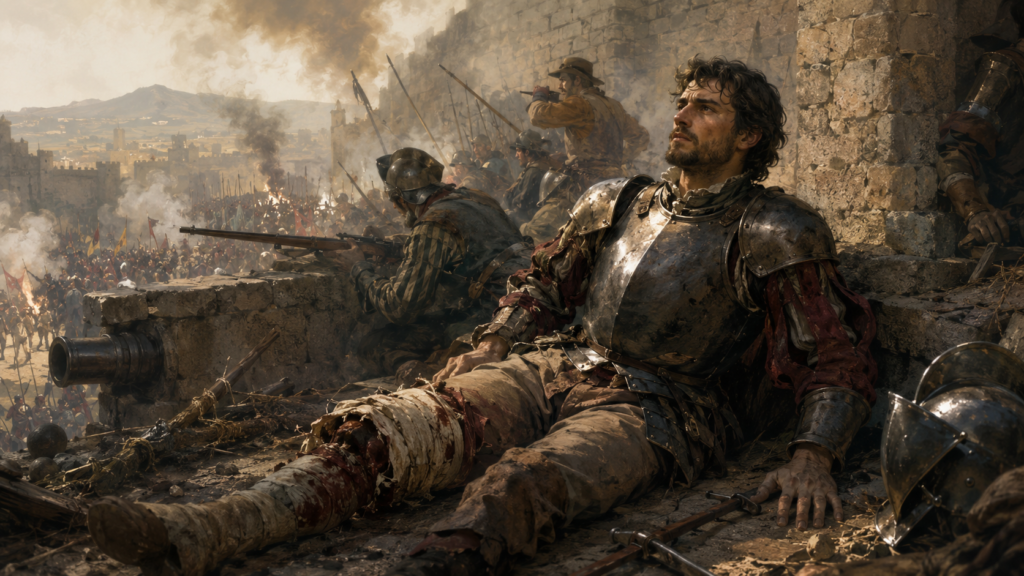
Ignatius himself, dictating the account of his pilgrimage at the end of his life to Fr. Luis Gonçalves da Câmara, portrays himself without mercy: “Up to the age of twenty-six he was a man given over to the vanities of the world, and his chief delight was in the exercise of arms, with a great and vain desire to win honor.”² There is no true conversion without truth about oneself. The wounded man was carried to the ancestral tower-house of Loyola, where he endured —without complaint, out of sheer knightly vanity— having the badly-set leg broken again and a protruding bone sawed off, because it spoiled the fit of the courtier’s close-fitting boot.
And then came the miracle of Providence disguised as boredom. Íñigo asked for books of chivalry to pass the convalescence. There were none in the house. They found only two: the Vita Christi of Ludolph of Saxony, the Carthusian, and the Flos Sanctorum, the lives of the saints by Jacobus de Voragine. Reading, the knight discovered other knights: Francis of Assisi, Dominic de Guzmán. And he said to himself: “Saint Dominic did this; therefore I must do it. Saint Francis did this; therefore I must do it.”³ Note well: the conversion of Ignatius did not annul his combative temperament; it transfigured it. God does not destroy nature; He elevates it. The same point of honor that kept him on the ramparts of Pamplona would later hurl him into the conquest of souls.
In that sickbed at Loyola there was also born, almost unnoticed, the art that Ignatius would bequeath to the Church: the discernment of spirits. He observed that thoughts of worldly vanities delighted him while they lasted, but left him “dry and discontented”; whereas thoughts of imitating the saints not only consoled him in the moment, but left him “content and joyful” even after they had passed.⁴ From this humble observation —a soldier taking the pulse of his own soul— would spring the Rules for the Discernment of Spirits in the Spiritual Exercises (SE 313-336), one of the finest treasures in all of Christian spirituality.
The Vigil of Arms at Montserrat: Chivalry Baptized
His body healed and his soul on fire, Íñigo left Loyola in February 1522. His first destination was not a seminary or a university: it was the shrine of Our Lady of Montserrat, in Catalonia. And there he performed one of the most beautiful and most eloquent gestures in the entire history of Christian sanctity.
He confesses it himself in his Autobiography: “And as his mind was full of those ideas, Amadís de Gaula and other such books, thoughts corresponding to them came to him; and so he determined to keep a vigil of arms for a whole night, without sitting or lying down, but standing at times and at times kneeling, before the altar of Our Lady of Montserrat, where he had resolved to leave his garments and clothe himself in the armor of Christ.”⁵
The vigil of arms was the solemn rite by which the squire spent the night in prayer before his weapons, keeping watch over them, before being knighted at dawn. Ignatius knew the rite from the novels of chivalry —he himself cites the Amadís— and from the Hispanic tradition; the Siete Partidas of Alfonso X the Wise prescribed that the aspirant to knighthood keep vigil over his arms in a church, praying, before his investiture.⁶ And so, on the night of March 24-25, 1522 —the vigil of the Annunciation, when the Word became flesh in Mary— Íñigo kept the vigil of his arms before the Black Madonna of Montserrat. Beforehand, he had made a written general confession over three days to the Benedictine monk Jean Chanon. He had given his rich garments to a poor man and put on a pilgrim’s sackcloth. And when the vigil ended, he hung his sword and his dagger on the grille of Our Lady’s altar.⁷
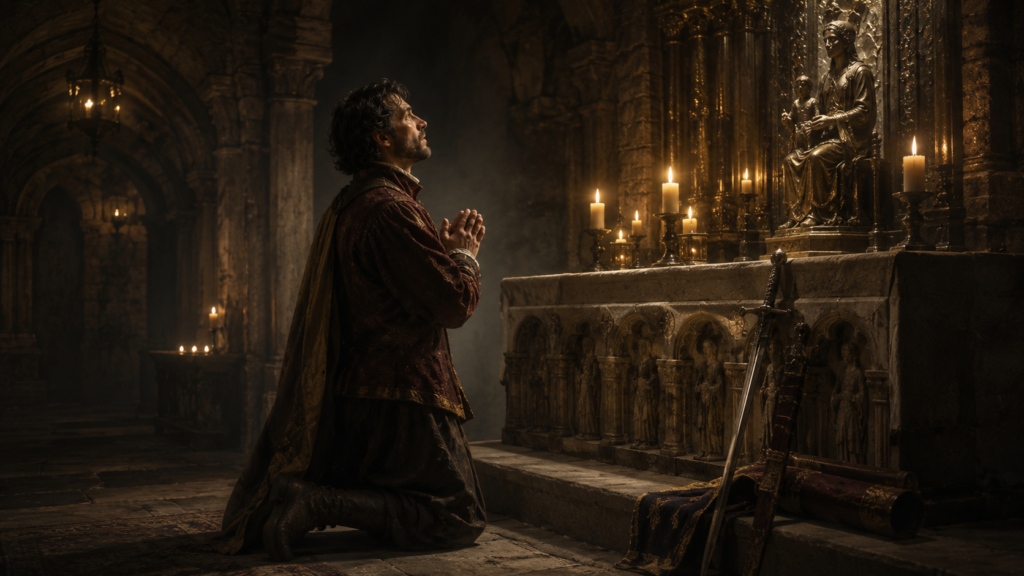
Let us grasp the theological depth of the gesture. Ignatius did not simply abandon his chivalric ideal: he baptized it and placed it entirely at the service of Christ. In a spiritual sense, his true knighthood began that night. He changed lords, not vocation. He laid down the weapons of steel to take up “the armor of Christ,” exactly as the Apostle commands: “Put on the full armor of God… with the belt of truth buckled around your waist, with the breastplate of righteousness in place… take up the shield of faith… take the helmet of salvation and the sword of the Spirit, which is the Word of God” (Eph 6:11-17). His first biographer, Fr. Pedro de Ribadeneira, who knew him and lived with him, describes it with precision: at Montserrat, Ignatius offered himself “as a new soldier of Jesus Christ,” beginning “a new knighthood.”⁸ Medieval chivalry, which the Church had always sought to baptize —think of Saint Bernard of Clairvaux’s In Praise of the New Knighthood— found in that limping pilgrim from Guipúzcoa its purest fulfillment: a knight whose only lady would be the Virgin, whose only King would be Christ, and whose battlefield would be the whole world.
Manresa: The Cave Where God Schooled a Soldier
From Montserrat, Ignatius went down to the nearby town of Manresa, planning to stay a few days. He stayed almost eleven months. And there, between a cave beside the river Cardoner, the hospital of Santa Lucía, and seven hours of daily prayer, God Himself took charge of training His recruit. Ignatius said it with an unforgettable image: at Manresa “God treated him just as a schoolmaster treats a child, teaching him.”⁹
He passed through everything: the loftiest consolations, scruples that drove him to the edge of despair, extreme penances, subtle temptations. And in the midst of it all, the mystical graces: the vision of the humanity of Christ, “like a white body,” which he contemplated many times and which confirmed him in the faith with such force that he came to say that even if Scripture did not exist, he would be ready to die for what he had seen;¹⁰ the vision of the Most Holy Trinity “in the figure of three keys,” which made him weep for joy until dinnertime and of which he could not stop speaking.¹¹
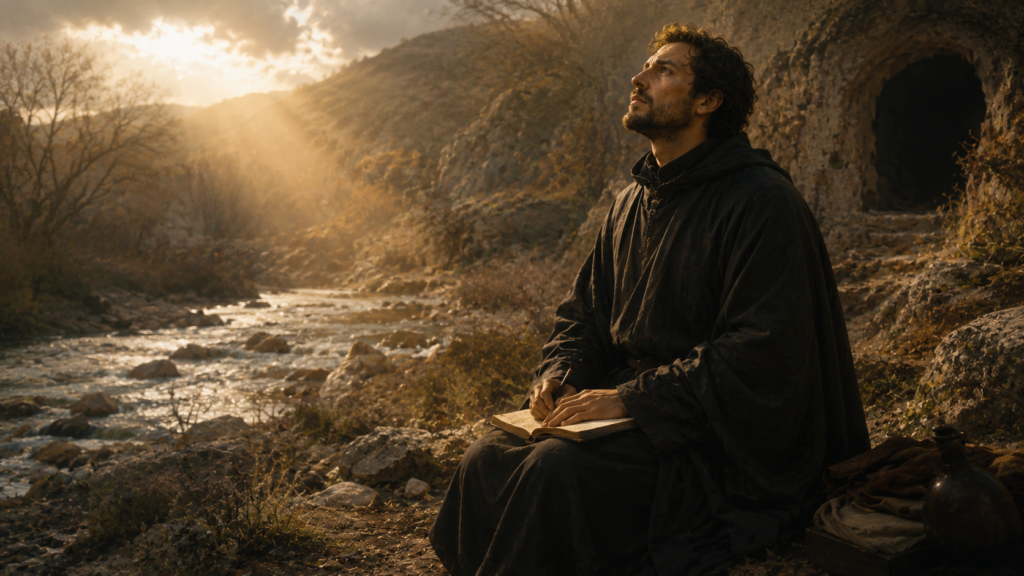
The summit was the illumination of the Cardoner. Sitting one day beside the river, “the eyes of his understanding began to open; not that he saw any vision, but he understood and knew many things, both spiritual matters and matters of faith and of learning; and this with so great an enlightenment that everything seemed new to him.” And the aged Ignatius adds, measuring his words: if he gathered together all the helps received from God and everything he had learned in sixty-two years of life, he does not think he had attained as much “as at that one time.”¹² From that wellspring of Manresa flowed the book that would change the spiritual history of the West: the Spiritual Exercises, which Ignatius began to jot down right there — not as a treatise to be read, but as a combat manual to be done: a month of intensive training for the soul.
Principle and Foundation: The Rock on Which Everything Rests
The Exercises open with a text of granite sobriety, which Saint Ignatius called the “Principle and Foundation,” and which is, perhaps, the densest summary of Christian existence ever written outside of Scripture:
“Man is created to praise, reverence, and serve God our Lord, and by this means to save his soul; and the other things on the face of the earth are created for man, and that they may help him in pursuing the end for which he is created. Hence it follows that man is to use them insofar as they help him toward his end, and he must rid himself of them insofar as they hinder him. Therefore it is necessary to make ourselves indifferent to all created things… desiring and choosing only what most leads us to the end for which we are created” (SE 23).¹³
Everything is here: man is not an accident, he is a creature with a mission; things are not ends, they are means; freedom does not consist in doing what one wants, but in becoming free of everything in order to choose “what most” leads to God. That magis —that “more”— is Ignatius’s signature. The good is not enough for him: he seeks the better. The glory of God is not enough for him: he seeks “the greater glory of God,” Ad maiorem Dei gloriam, the motto the Society would engrave on its schools, its missions, and its martyrs. It is the logic of Saint Paul’s athlete: “Do you not know that in a race all the runners run, but only one gets the prize? Run in such a way as to get the prize” (1 Cor 9:24). And it is the logic of the soldier: Ignatian indifference is not stoic apathy but military availability; the soldier does not choose his front — he stands ready for any of them.
The Two Standards: The Meditation of Combat
If the Principle and Foundation is the rock, the meditation on the Two Standards (SE 136-148) is the warrior heart of the Exercises, and one of the most dramatic pages in the world’s spiritual literature. On the fourth day of the Second Week, Ignatius has the exercitant contemplate two camps, two armies, two captains: “the one of Christ, our supreme Captain and Lord; the other of Lucifer, mortal enemy of our human nature.”¹⁴
The exercitant must see with the imagination “a great plain embracing the whole region of Babylon, where the chief of the enemy is seated on a great throne of fire and smoke, in a figure horrible and terrifying,” haranguing his demons and sending them throughout the whole world to lay before men his chain of three links: riches, worldly honor, pride. And facing him, “a lowly place, beautiful and gracious” near Jerusalem, where Christ, “supreme Captain General of the good,” sends His friends throughout the whole world “desiring to help all,” with the exactly inverse strategy: poverty against riches, insults against worldly honor, humility against pride.¹⁵
Ignatius invents nothing: he translates the naked Gospel into the language of a military campaign. “No one can serve two masters” (Mt 6:24). “Whoever is not with me is against me” (Lk 11:23). “I have not come to bring peace, but a sword” (Mt 10:34) —not the sword of violence, but the radical decision that the Gospel provokes in every heart that hears it—. The Christian life is not a neutral garden: it is a battlefield where, in the spiritual order, there is no definitive neutrality; sooner or later every soul decides which logic governs its choices, and whoever does not choose consciously is already being chosen by the currents of the world. And the meditation culminates in the most Ignatian petition of all: to ask to be received under the standard of Christ, “in the highest spiritual poverty… and in bearing insults and injuries, so as to imitate Him more closely in them.” The knight of Montserrat asks, for himself and for all who would make the Exercises after him, the soldier’s supreme honor: to be placed with the Captain in the front line — which is the Cross.
This meditation is sister to another equally glorious one, the Call of the Eternal King (SE 91-98), where Christ calls as a temporal king calls to his crusade: “Whoever wishes to come with Me must labor with Me, so that following Me in suffering, he may also follow Me into glory.” It is the exact echo of the Lord: “Whoever wants to come after me must deny himself, take up his cross, and follow me” (Mt 16:24), and of Paul the veteran: “I have fought the good fight, I have finished the race, I have kept the faith” (2 Tim 4:7).
Regimini Militantis Ecclesiae: The Society Is Born
Out of the solitary pilgrim, God made a founder. Ignatius understood that in order to “help souls” he needed learning, and with heroic humility —a nobleman past thirty— he sat among children to learn Latin in Barcelona, and then studied at Alcalá, Salamanca, and finally Paris, where he won over, one by one, through the Exercises, his first companions: the Savoyard Peter Faber; the Navarrese Francis Xavier —brilliant, athletic, ambitious, whom Ignatius won by repeating to him the word of the Lord: “What does it profit a man to gain the whole world and lose his soul?” (Mk 8:36)—; the Spaniards Diego Laínez, Alfonso Salmerón, and Nicolás de Bobadilla; and the Portuguese Simão Rodrigues. On August 15, 1534, in the chapel of Montmartre, the seven vowed poverty, chastity, and to go to Jerusalem or, if that proved impossible, to place themselves at the disposal of the Pope.
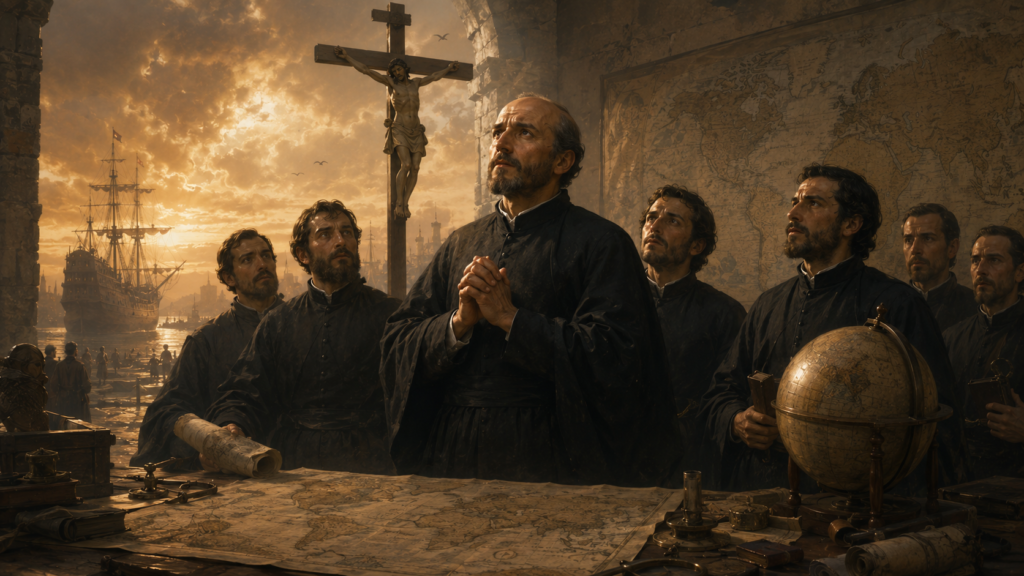
Jerusalem proved impossible; the world proved possible. On September 27, 1540, Pope Paul III approved the new order with a bull whose very title is a whole program: Regimini militantis Ecclesiae — “For the Government of the Church Militant.” Even the founding document speaks the idiom of combat. And in the Formula of the Institute, drafted by Ignatius and approved by the Pope, the Jesuit is defined in the words of an enlistment: “Whoever desires to serve as a soldier of God beneath the banner of the cross in our Society, which we desire to be designated by the name of Jesus, and to serve the Lord alone and the Church His spouse, under the Roman Pontiff, the Vicar of Christ on earth…”¹⁶ To fight beneath the banner of the cross: the meditation on the Two Standards made canon law.
Shortly before, on the road to Rome in 1537, in the little chapel of La Storta, Ignatius received the grace that sealed everything: he saw the Father placing him with His Son carrying the cross, and heard the words “I will be favorable to you in Rome.” Ignatius, who had begged the Virgin incessantly “to be placed with her Son,” understood that the Society was not his: it belonged to Jesus, and that is why he never consented that it bear any other name.¹⁷
And it is worth underlining, to the glory of Spain and of the whole Hispanic world, what Ignatius himself embodied: Hispanic nobility placed at the service of the Gospel. Ignatius was a nobleman of a house of arms; Francis Xavier, a son of the castle of Javier in Navarre; and a few years later there would enter the Society none other than Saint Francis Borgia, Duke of Gandía, grandee of Spain, Viceroy of Catalonia, and great-grandson of a king, who left titles, palaces, and viceroyalty to become one more Jesuit, and ended as the order’s third Superior General. An astonished Europe coined the phrase: the holy duke. The Society proved that the highest blood of Christendom could be shed, not in duels of honor, but in the militia of Christ.
The Lions of the Church: The Missionary Epic
And then the world learned what a company of men in love with Christ and trained in the Exercises can do. Even before the official approval, Francis Xavier was setting out for the Indies (1540): Goa, the Fishery Coast, the Moluccas, Japan —where he founded the first Japanese Christian community— and he died in 1552 on the island of Shangchuan, at the very gates of China, consumed by the desire to enter the closed empire. He baptized tens of thousands; the Church venerates him as patron of the missions alongside Saint Thérèse. His cry, written from India to the university men of Europe who were squandering their talents, still resounds: how many souls fail to reach heaven for lack of someone to help them!¹⁸
Where Xavier stopped, others carried on. The Venerable Matteo Ricci —declared Venerable by Pope Francis in 2022— achieved the impossible: he entered China, reached Peking, dressed as a Confucian scholar, astonished the mandarins with mathematics, astronomy, and maps, and opened the court of the Middle Kingdom to the Gospel. In America, Saint Peter Claver made himself in Cartagena de Indias “the slave of the black slaves forever,” baptizing and consoling —according to the testimonies of his canonization process, hundreds of thousands— of the Africans torn from their homeland;¹⁹ the Jesuits raised up in Paraguay the Reductions, that Christian Guaraní republic which drew praise even from the philosophers of the Enlightenment themselves;²⁰ Saint José de Anchieta evangelized and all but founded Brazil, writing poems to the Virgin in the sand of the beach; and in New Spain, where they arrived in 1572, they sowed colleges from Mexico City to the Californias, where Fr. Eusebio Kino rode the deserts as explorer and apostle. In the north, the Canadian Martyrs —Saint Jean de Brébeuf, Saint Isaac Jogues, and companions— watered the missions among the Hurons with heroic blood, while in England Saint Edmund Campion mounted the scaffold at Tyburn for the faith. And in the lecture halls of Europe, Saint Robert Bellarmine and Saint Peter Canisius, Doctors of the Church, upheld Catholic truth in the full fury of the Protestant storm.
They were, in truth, the lions of the Church: they hurled themselves upon every sea, learned every language, wore every garb, died every death. They fulfilled to the letter the command of the Captain: “Go into all the world and preach the Gospel to every creature” (Mk 16:15). Like the grain of wheat that falls into the earth and dies to bear much fruit (cf. Jn 12:24), they sowed their lives in Asia, Africa, and America — and the harvest endures still.
And the Society endures still. Almost five centuries after the vigil of arms at Montserrat —through persecutions, suppression (1773), and restoration (1814)— the Society of Jesus remains one of the largest male religious orders in the Church, with close to fourteen thousand Jesuits present in some one hundred and ten countries, sustaining a worldwide network of universities, schools, social works, the Jesuit Refugee Service, and missions on every frontier.²¹ The numbers fluctuate; the charism does not.
A Spirituality for Every Frontier
Here we touch the secret of Ignatian fruitfulness, and the lesson for each one of us. The Jesuit —and everyone who lives the spirituality of Saint Ignatius— does not have a single mission field, because his mission field is wherever there is a frontier and a greater need. Ignatius did not bind his sons to the choir, or to a habit, or to the cloister: he wanted them to be “contemplatives in action,” in the immortal formula of Fr. Jerónimo Nadal — men capable of “finding God in all things.”²² That is why the Jesuit has been able to be, without ceasing to be himself, a missionary in Japan and an astronomer in Peking, a theologian at Trent and a schoolmaster of children in a village, a chaplain of galley slaves and a confessor of kings, a poet and a martyr. The indifference of the Principle and Foundation, and the availability expressed in a special way in the fourth vow of obedience to the Pope —made by the professed Jesuits— make the Ignatian a soldier of universal deployment: wherever the Eternal King points, there he goes.
This spirituality has overflowed the walls of the Society and fertilized the whole Church. The Spiritual Exercises have formed saints of every family: Saint Charles Borromeo made them and promoted them; Saint Francis de Sales drank from them; Saint Alphonsus Liguori recommended them; Pius XI declared Saint Ignatius patron of all spiritual exercises.²³ And it is beautiful to recall —for those of us who love Vincentian charity— that Saint Vincent de Paul himself, when beginning the experience of the Congregation of the Mission, looked with admiration upon the sons of Ignatius: his biographers record how he consulted the Jesuits and sought their counsel in the beginnings of his popular missions, how he esteemed the spiritual exercises as an instrument of conversion and incorporated them into the life of his congregation, and how he counted friends and advisers among the Jesuits.²⁴ The great captain of charity learned tactics from the great captain of the missions: in the Church, charisms do not compete; they enrich one another, for “there are diversities of gifts, but the same Spirit” (1 Cor 12:4).
And for Spain and for the whole Hispanic world, Ignatius and his sons are a title of imperishable glory: in the very century in which the Hispanic caravels were opening the seas, a limping Basque was opening the roads of the soul, and his sons carried —together with Castile and Portugal, and often farther than they— the faith, letters, and Christian dignity to four continents.
“In All Things, to Love and to Serve”
Ignatius died in Rome at dawn on July 31, 1556, without noise, without drama, like a soldier handing over the watch. He left behind about a thousand Jesuits, a hundred houses and colleges, Constitutions chiseled word by word, and a small book of Exercises that would go on converting hearts for centuries. He was canonized by Gregory XV on March 12, 1622, in that unrepeatable ceremony in which there ascended to the altars together Ignatius of Loyola, Francis Xavier, Teresa of Jesus, Philip Neri, and Isidore the Farmer —and Rome joked that the Pope had canonized “four Spaniards and a saint.”
The Exercises end with the Contemplation to Attain Love, where the warrior is finally revealed as what he always was: a lover. “Love ought to be placed more in deeds than in words” (SE 230). And there Ignatius hands over his supreme prayer, the total surrender of the knight to his King:
“Take, Lord, and receive all my liberty, my memory, my understanding, and my entire will, all that I have and possess; You have given it all to me, to You, Lord, I return it; all is Yours, dispose of it wholly according to Your will; give me Your love and Your grace, for this is enough for me” (SE 234).
This is the inheritance we celebrate every July 31. May Saint Ignatius obtain for us his grace of combat: the courage to keep the vigil of our arms before the Virgin and never take them back; the clear sight of the Two Standards, so as never to serve the enemy, not even through carelessness; the indifference of the Principle and Foundation, so as to stand available for any frontier; and the fire of Manresa, so that all our action may spring from contemplation. For the Christian life remains what he saw from his wounded man’s bed: a glorious campaign under the standard of the Cross — “and this is the victory that has overcome the world: our faith” (1 Jn 5:4).
Saint Ignatius of Loyola, knight of Christ and captain of souls, pray for us!
Ad maiorem Dei gloriam.
Notes and References
- For the biography as a whole: Ricardo García-Villoslada, S.J., San Ignacio de Loyola. Nueva biografía, Madrid, BAC, 1986; and Cándido de Dalmases, S.J., Ignatius of Loyola, Founder of the Jesuits: His Life and Work, St. Louis, Institute of Jesuit Sources, 1985 (original Spanish: Madrid, BAC, 1979).
- Saint Ignatius of Loyola, Autobiography (A Pilgrim’s Journey, dictated to Fr. Luis Gonçalves da Câmara), no. 1; standard editions in Obras de San Ignacio de Loyola, ed. I. Iparraguirre – C. de Dalmases, Madrid, BAC; English translations by Joseph N. Tylenda, S.J., and by Parmananda Divarkar, S.J.
- Autobiography, no. 7.
- Autobiography, no. 8: the experiential origin of the discernment of spirits.
- Autobiography, no. 17.
- Alfonso X the Wise, Las Siete Partidas, Partida II, Title XXI, law 13, on the vigil of arms of the new knight.
- Autobiography, no. 18; cf. Pedro de Leturia, S.J., Íñigo de Loyola (English trans., Syracuse, 1949; Spanish: El gentilhombre Íñigo López de Loyola en su patria y en su siglo, Barcelona, Labor, 1949), the classic study of Ignatius’s chivalric background.
- Pedro de Ribadeneira, S.J., Vida del P. Ignacio de Loyola (1583), book I, chs. 3-4 — the first great biography, written by a direct witness.
- Autobiography, no. 27.
- Autobiography, no. 29.
- Autobiography, no. 28.
- Autobiography, no. 30: the illumination of the Cardoner.
- Saint Ignatius of Loyola, Spiritual Exercises, no. 23 (Principle and Foundation).
- Spiritual Exercises, nos. 136-137.
- Spiritual Exercises, nos. 138-147; cf. Hugo Rahner, S.J., Ignatius the Theologian and The Spirituality of St. Ignatius Loyola (Spanish: Ignacio de Loyola y su histórica formación espiritual, Santander, Sal Terrae, 1955).
- Paul III, bull Regimini militantis Ecclesiae (September 27, 1540), which contains the Formula of the Institute of the Society of Jesus.
- Autobiography, no. 96 (the vision of La Storta); cf. Cándido de Dalmases, op. cit.
- Saint Francis Xavier, letter to Ignatius of Loyola and the companions in Rome, Cochin, January 15, 1544, in The Letters and Instructions of Francis Xavier, trans. M. Joseph Costelloe, S.J., St. Louis, Institute of Jesuit Sources, 1992 (Spanish critical edition: Cartas y escritos de San Francisco Javier, ed. Félix Zubillaga, S.J., Madrid, BAC, 1996): there he expresses his desire to run through the universities of Europe “crying out like a man who has lost his mind” for the souls being lost for lack of laborers.
- The formula of Claver’s fourth vow is preserved in his canonization process; on his life and the scope of his apostolate: Ángel Valtierra, S.J., Peter Claver: Saint of the Slaves, London, Burns & Oates, 1960 (Spanish: Pedro Claver, el santo que libertó una raza, Bogotá, 1954).
- Cf. Voltaire, Essai sur les mœurs et l’esprit des nations (1756), ch. CLIV, where the patriarch of the Enlightenment acknowledges the Paraguay missions as “a triumph of humanity”; also Ludovico Antonio Muratori, Il cristianesimo felice nelle missioni de’ padri della Compagnia di Gesù nel Paraguai (1743).
- Data from the General Curia of the Society of Jesus (jesuits.global) and the Annuario Pontificio, which in the mid-2020s place the Society at around fourteen thousand members in some one hundred and ten countries; cf. John W. O’Malley, S.J., The First Jesuits, Cambridge (MA), Harvard University Press, 1993, for the founding history. On the Venerable Matteo Ricci: decree of heroic virtues approved by Pope Francis, December 17, 2022.
- Jerónimo Nadal, S.J., in Monumenta Historica Societatis Iesu (Epistolae P. Hieronymi Nadal), on the ideal of the contemplativus in actione and of “finding God in all things.”
- Pius XI, apostolic constitution Summorum Pontificum (July 25, 1922), declaring Saint Ignatius heavenly patron of all spiritual exercises; cf. also his encyclical Mens Nostra (December 20, 1929) on the promotion of the exercises.
- Cf. Louis Abelly, La vie du vénérable serviteur de Dieu Vincent de Paul (Paris, 1664), the first biography of the saint, and José María Román, C.M., St. Vincent de Paul: A Biography, London, Melisende, 1999 (Spanish: Madrid, 1981), on Vincent’s consultations with members of the Society in the origins of the Congregation of the Mission and the Vincentian esteem for the spiritual exercises as a missionary instrument.
Other biblical sources cited: 1 Tim 1:18-19; Eph 6:10-17; Mt 6:24; Mt 10:34; Mt 16:24; Mk 8:36; Mk 16:15; Lk 11:23; Jn 12:24; 1 Cor 9:24; 1 Cor 12:4; 2 Tim 4:7; 1 Jn 5:4.