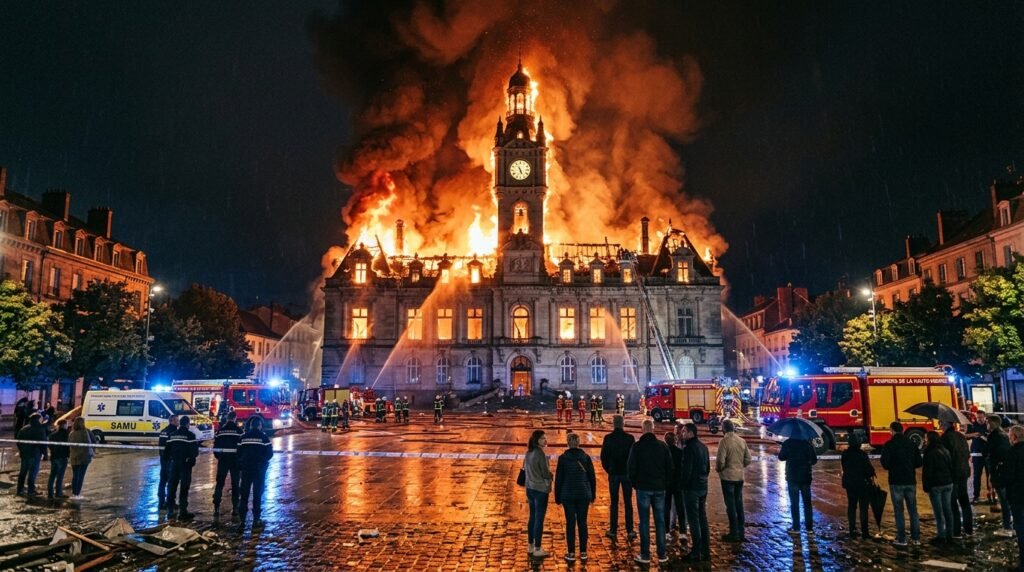
On Saturday, October 17, 2026, the bell tower of the Limoges City Hall went up in flames — a building dating from 1883 that officials later described as “largely lost.” That same night in Marseille, several churches were broken into; in the 19th arrondissement of Paris, a synagogue was found with its Torah ark thrown open and its holy books scattered across the floor; in Lyon, an interreligious march for peace had to be postponed. Barely three weeks earlier, Pope Leo XIV had stood in the Place de la Concorde and asked the French people to build “a nation renewed from its roots, watered by faith.”
Between that homily and that fire lies the whole question of this article: what happens to a civilization that forgets where it came from? And the answer we want to give — sources in hand and without fear — is this: Europe was born at the baptismal font, and only by returning to it — not with the sword, but with the spirit that once rose at Covadonga — can Europe go on being Europe.
I. What burned in October, and what is really at stake
Let us begin with honesty. The October riots were not born as a religious uprising. They began in mid-September as a protest by high-school students over the condition of their schools; labor unions and “yellow vests” protesting the cost of living joined later; and on October 17 more than half a million people marched — the vast majority of them peacefully. The French government attributes the violence — more than two thousand arrests, hundreds of police officers injured, public buildings set on fire — to organized cells of the radical far left, joined by criminals who came to loot. Several European leaders and the President of the United States have instead blamed immigration; French authorities have not established that, and the debate remains open.
A week later, the wave reached Spain. On Saturday, October 24, a call spread through social media drew hundreds of young people to Barcelona’s Plaça de Catalunya, most of them dressed in black and many with their faces covered. The evening ended with fourteen shops looted, trash bins in flames, barricades on the Passeig de Gràcia, fifteen officers injured — four of them seriously — and 128 people arrested, 73 of them minors. The Catalan Interior Department saw the gathering as a possible echo of the European protests held that same day, and Interior Minister Núria Parlon described the rioters as unorganized groups defending no right whatsoever. The Mossos have not released the nationalities of those arrested, but police sources quoted by several Spanish outlets say many come from families of foreign origin — from the Maghreb and also from South America, among other places — though a good number hold Spanish ID. They are not newcomers: they are, in large part, young people born or raised in Europe whom no one has taught the worth of what they are destroying. It is the most troubling face of the integration failure we will turn to below.
We say this not to minimize what happened, but to see it more clearly. Because what these days lay bare is something deeper than who was responsible for a night of looting: an entire generation that no longer knows why a bell tower, an altar, or a tabernacle deserves respect. Those who forced their way into the churches of Marseille did not need a Qur’an in their hands; it was enough to have nothing in their souls. Europe’s first enemy does not come from outside: it is the nihilism that hollows her out from within.
And yet it would also be a lie to keep silent about the other danger, which is anything but hypothetical. On July 26, 2016, two jihadists slit the throat of Father Jacques Hamel while he was celebrating Mass in Saint-Étienne-du-Rouvray. On October 29, 2020, an Islamist terrorist murdered three of the faithful in the Basilica of Notre-Dame in Nice. The great suburban riots of 2005 and 2023 — in which some churches also burned — revealed integration failures that half of Europe refused for decades to name. There is a political Islamism that makes no secret of its project, and there are neighborhoods where the common law is in retreat.
The two threats are not rivals; they are complementary. Where Christianity empties out, something fills the void. A Europe without a soul is not a neutral Europe; it is an empty house, and empty houses are always eventually occupied — by consumerism, by ideology, or by another faith more sure of itself. That is why the underlying problem is not how many arrive, but what they find when they arrive: a civilization that knows who it is, or a museum whose guards have forgotten what they are guarding.
II. Europe was born at the baptismal font
Europe is not a continent: geographically it is little more than a peninsula of Asia. Europe is a form, and that form was given to her by the Gospel. When Saint Remigius baptized Clovis at Reims at the end of the fifth century, France was born; when Benedictine monks copied Virgil and Aristotle in their scriptoria, they saved the memory of Greece and Rome; when Cyril and Methodius gave the Slavs an alphabet, the other half of the continent was born. From the cathedral schools came the universities; from monastic hospitalitas, the hospitals; from the theology of the person — every human being an image of God, every soul of infinite worth — came, though their heirs have forgotten it today, the human dignity, equality before the law, and human rights that secular Europe proclaims as its own.
That is why Saint John Paul II, in the cathedral of Santiago de Compostela on November 9, 1982, launched the cry that remains the program of every European Christian: “Europe, find yourself again. Be yourself. Discover your origins. Revive your roots.” Twenty years later, in the apostolic exhortation Ecclesia in Europa (2003), he diagnosed what was happening with an expression that has since become proverbial: a “silent apostasy” on the part of comfortable people who live as if God did not exist (no. 9). Not a bloody persecution, but a comfortable forgetting.
Pope Leo XIV has taken up that torch. In Madrid he warned that the religiosity that animates Spain must not become a museum of the past to be visited; in France, addressing the bishops, he affirmed that the Church remains part of the nation’s culture, identity, and vocation, and urged them not to renounce their public voice. A continent ashamed of its cathedrals is a continent ashamed of itself. And whoever is ashamed of his father will, sooner or later, accept another.
III. An unexpected springtime
For decades, Europe’s religious chronicle read like a casualty report: empty seminaries, merged parishes, generations that stopped baptizing their children. Saint John Paul II was not exaggerating when he spoke of a silent apostasy. But the history of the Church is never written in a straight line, and what we are seeing today in France, in Spain, and even in the United Kingdom is something few sociologists foresaw: the young are coming back.
In France, adult baptisms have broken records year after year: at Easter 2025 they exceeded ten thousand, and among them the number of university students and teenagers is growing strikingly — many with no prior Christian formation at all, some from Muslim families. The Pentecost pilgrimage from Paris to Chartres fills with young people to the point of having to close registration. Seven hundred thousand people came to the Place de la Concorde to welcome the Pope this September. In Spain, youth Eucharistic adoration, retreats, and movements filling churches with people in their twenties are flourishing, and Leo XIV’s visit to Madrid was a triumph. In England, a Bible Society study (The Quiet Revival, 2025) recorded a notable rise in church attendance among young adults.
The countries that were once bulwarks of the faith and centers of mission are once again, in the best sense of the word, mission territory: not lost ground, but fields white for the harvest (cf. John 4:35). This youth searching for roots, beauty, and truth is the best news Europe has. But every spring has its frosts, and it would be naive to ignore the ones that threaten this one.
IV. The British mirror and a changing Spain
If France shows the danger of the void, the United Kingdom shows the danger of fragmentation. London, which a century ago was the capital of a Christian empire, today has a Muslim population of around 15 percent according to the 2021 census, compared with 6.5 percent in England and Wales as a whole. Many visitors — and not a few of its own residents — say that some neighborhoods of the city have become almost unrecognizable.
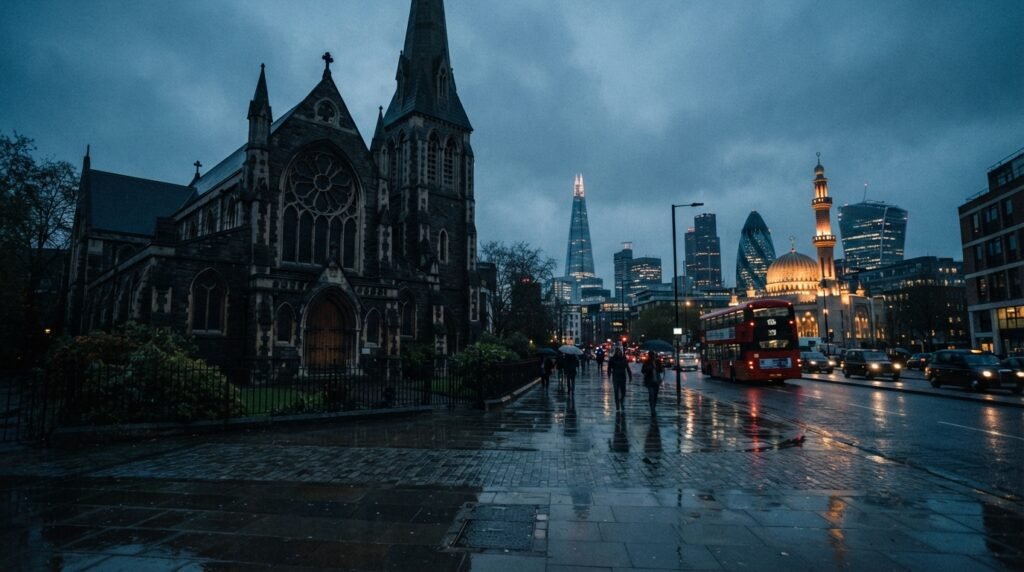
The problem is not that Muslims pray in London: religious freedom is a conquest that Christianity taught Europe. The problem is that, in certain neighborhoods, entire communities live parallel lives, without making their own the language, customs, or principles of the society that welcomed them. As early as 2016, Dame Louise Casey’s review of integration, commissioned by the British government itself, warned of growing segregation in some communities and of regressive practices incompatible with equality before the law, especially to the detriment of women. An independent Home Office review (2018) examined the so-called sharia councils that operate in the country as parallel religious arbitration bodies. It is in that isolation that Islamism recruits and advances. And the phenomenon is beginning to find political expression: in the 2024 general election, several independent candidates, carried largely by the votes of Muslim communities rallying around the cause of Gaza, won seats in Parliament — a vote of religious and communal identity that British politics had scarcely known.
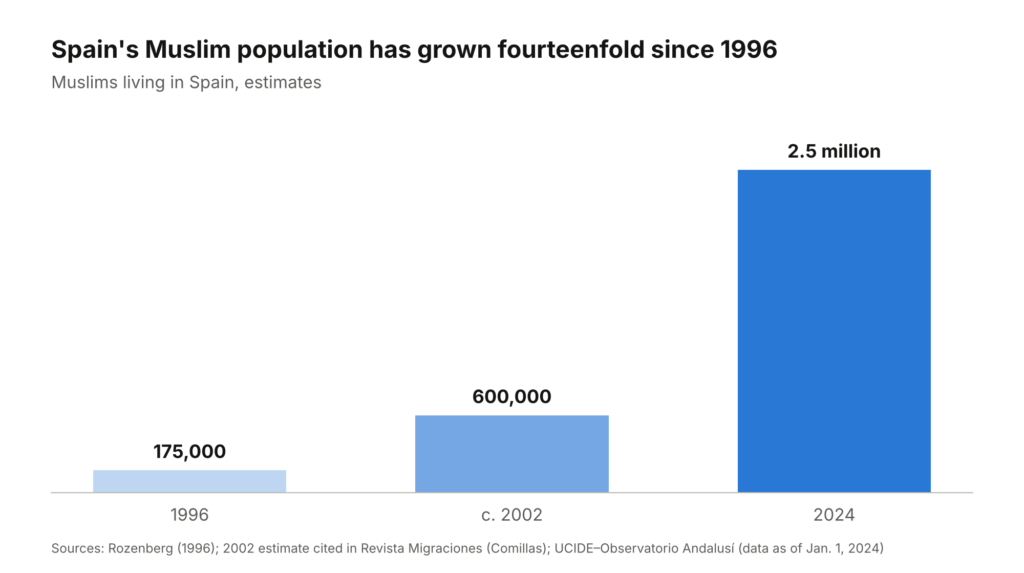
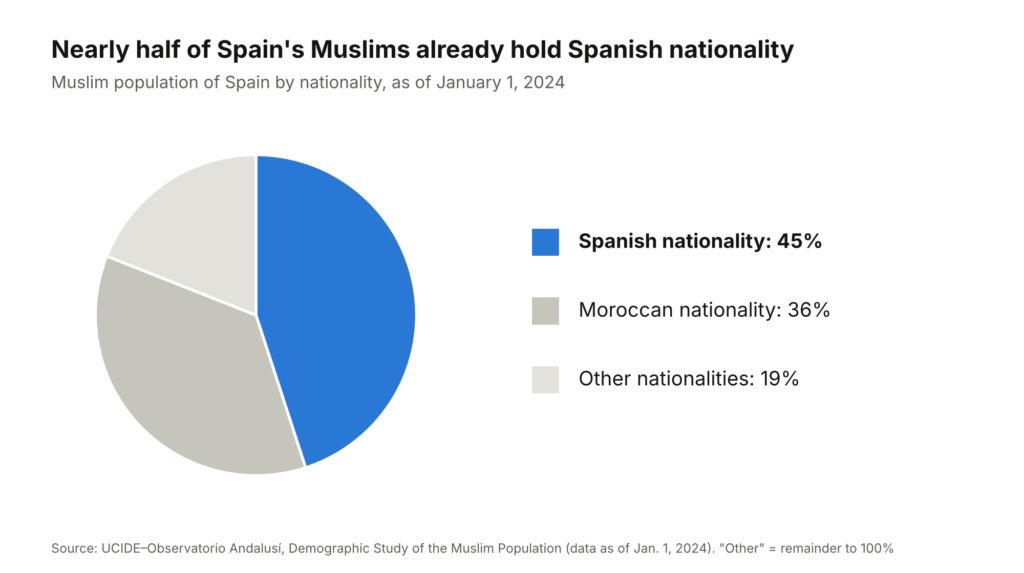
Spain is no exception. In 1996, scholars put the country’s Muslim population at around 175,000; at the start of this century, at about 600,000. Today it exceeds 2.5 million — roughly 5 percent of the population — according to the demographic study of the Union of Islamic Communities of Spain (UCIDE), with data as of January 1, 2024: 45 percent already hold Spanish citizenship, and most of the rest are Moroccan. By early 2025 there were 1,766 mosques and prayer halls in Spain. Barcelona is the municipality with the most Muslims in the country; in Melilla they are already more than half the population, and in Ceuta around 40 percent.
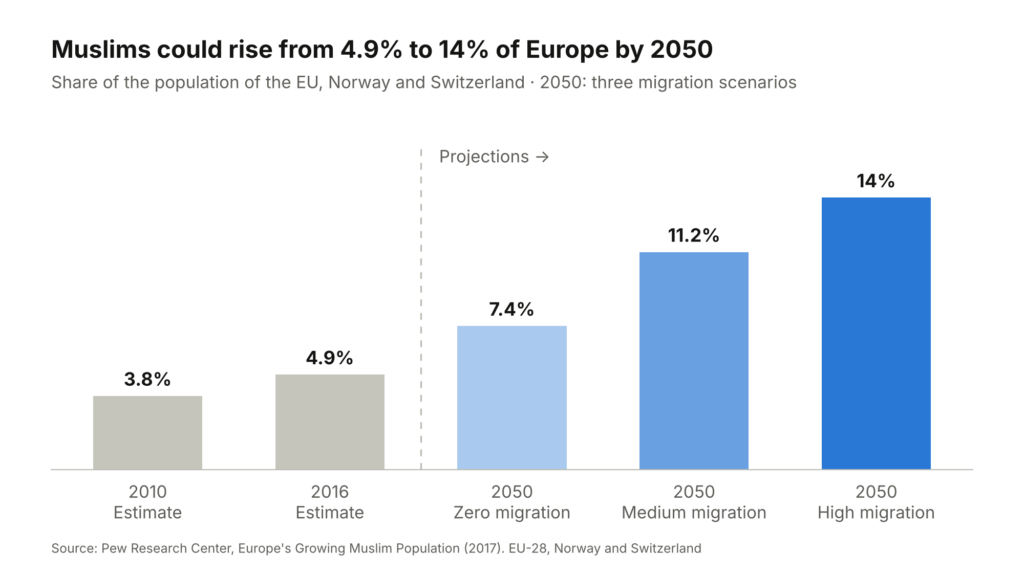
Europe as a whole follows the same curve. At the turn of the century, demographers estimated some 15 million Muslims in Western Europe, and in 2003 the Pew Forum put the figure at about 23 million for the whole continent, excluding Turkey and the former Soviet Union. According to the Pew Research Center, the Muslim population of the European Union, Norway, and Switzerland grew from 19.5 million in 2010 (3.8 percent) to 25.8 million in 2016 (4.9 percent), with migration the main driver of that growth. With a median age of 30, compared with 44 for other Europeans, their share would keep rising to 7.4 percent by 2050 even if immigration stopped completely, and could reach 11 or 14 percent depending on migration flows. No European country would have a Muslim majority, but the face of the continent will have changed profoundly in a single generation. Numbers alone are not a threat: the decisive question is whether those who arrive will find a culture with a soul to integrate into, or a void to fill with their own.
We must look at the whole picture: many British Muslims are fully integrated, and London’s Christian vitality is owed in large part to immigrants — Africans, Latin Americans, Poles, Filipinos — who fill its parishes. The dividing line does not run through passports or skin color, but through the willingness to make the common home one’s own. Immigration that integrates enriches; immigration that closes in on itself and refuses to recognize the ground it stands on ends up remaking that ground in its own image. And a society that, for fear of seeming intolerant, gives up asking for integration ends up paying the highest price of all: ceasing to be itself.
V. Covadonga: the spirit of the Reconquista
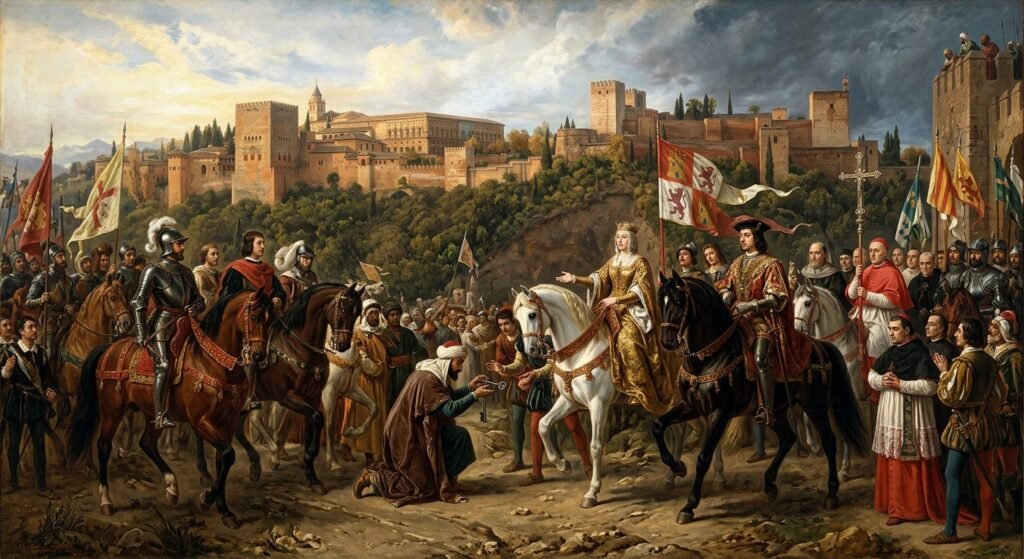
In the year 711 a Muslim army crossed the Strait of Gibraltar and in barely seven years conquered almost the entire peninsula. Visigothic Hispania — which had held illustrious councils and given the Church Saint Isidore — collapsed. The reasonable thing, what any analyst would have recommended, was to accept the new order. But in a cave in the Picos de Europa, beside an image of the Virgin, a handful of men led by Pelayo refused. Covadonga (c. 722) was not a great battle: it was a no. And out of that no came Spain.
The Reconquista lasted nearly eight centuries, until the surrender of Granada on January 2, 1492. For our own time, four traits are worth retaining, for they make up its true spirit:
1. The refusal to accept the loss of identity as destiny. The Christian kingdoms of the north were poor, small, and divided; they had everything against them but one thing: they knew who they were. The memory of Christian Hispania was their most precious capital.
2. The patience of centuries. No one who fought at Covadonga saw Granada. The Reconquista was the work of thirty generations who labored for grandchildren they would never meet. It is the virtue our age of instant gratification lacks most.
3. Faith as the soul of resistance. The Reconquista was waged under the patronage of Saint James, whose tomb made Compostela the spiritual heart of Europe, and it gave birth to its own orders of chivalry — Calatrava (1158), Santiago (1170), Alcántara, Montesa: monk-soldiers who joined the prayer of the hours to the service of arms. At Las Navas de Tolosa (1212), the kings of Castile, Aragon, and Navarre fought side by side: their common faith proved stronger than their rivalries.
4. Rebuilding. Every recovered land was resettled with churches, monasteries, charters, and schools. The Reconquista did not merely bring down a power: it built a civilization. The University of Salamanca (1218) is as much a child of the Reconquista as Las Navas.
Honesty once more: the Reconquista was no hagiography. There were centuries of coexistence and exchange — Mozarabs, Mudéjars, the Toledo School of Translators — and there were also pages the Church today cannot endorse: forced conversions, the expulsion of the Jews in 1492 and of the Moriscos in 1609. Since the Second Vatican Council, the Church teaches that faith cannot be imposed by coercion (Dignitatis humanae, 2). So when we speak of the spirit of the Reconquista, we are not speaking of expelling anyone or of taking up arms again. The land that must be reconquered today is not a territory: it is the soul of Europeans. Our Covadonga is the cave of the heart, where a Christian refuses to let his faith become a memory.
VI. The chivalry of redemption: Trinitarians and Mercedarians
There is a chapter of this history that says, better than any argument, what sets the Christian response apart. For centuries, thousands of Christians were captured by corsairs from North Africa and sold as slaves in Algiers, Tunis, or Tetouan. The Church’s response was not hatred: it was redemption. In 1198 Saint John of Matha founded the Order of the Most Holy Trinity to ransom captives; in 1218, in Barcelona, Saint Peter Nolasco founded the Order of Mercy, which added a fourth vow to the three religious vows: to remain as a hostage in the captive’s place if that was what it took to free him.
The most famous captive of Algiers was a soldier who had lost the use of his hand at Lepanto: Miguel de Cervantes. After five years of captivity and four escape attempts, he was ransomed in 1580 by two Trinitarian friars. Without Trinitarian charity there would be no Don Quixote: the greatest novel in the Spanish language owes its existence to an order that answered slavery by paying the price, not by striking back.
That is the lineage of the Christian response: firmness in identity, charity to the point of ransom. The Christian knight hates no one; that is why he can defend everything.
VII. Baptizing cultures, not subjugating them
Here lies the heart of the matter. Why was Christianity able to give form to peoples so different — Greeks and Germans, Celts and Slavs, Aztecs and Filipinos — without erasing them?
Because Christianity is not first a law, but a Person: the Logos, the Word made flesh. And the Word who became incarnate in a concrete culture took up what is human in order to purify and elevate it, not to annihilate it. As early as the second century, Saint Justin taught that every culture contains “seeds of the Word” (logoi spermatikoi) awaiting their fulfillment. Saint Paul, at the Areopagus, did not tear down the altar “to an unknown god”: he used it as a doorway (Acts 17:23). And in the year 601, Pope Saint Gregory the Great wrote to Abbot Mellitus, who was setting out to evangelize England, an instruction that amounts to a treatise on inculturation: do not destroy the temples of the pagans, destroy the idols; sprinkle the temples with holy water, set up altars and place relics in them, so that the people, seeing that their places are not destroyed, may come more readily to worship the true God.
This is how the Church has always acted at her best: the Christmas tree, harvest festivals, the art of every people, their languages and their music, were baptized and offered to God like the gifts of the Magi. Our Lady of Guadalupe appeared to an Indigenous man with the colors, symbols, and language of his own people. The philosopher Rémi Brague has put it memorably: Europe is “Roman” because it never believed itself to be the source of its own culture; it received the inheritance of Jerusalem and Athens knowing that it did not belong to it, and for that very reason it was able to pass it on enriched.
And Islam? Here we must speak with truth and with justice at the same time. Islamic civilization also received foreign inheritances: Baghdad translated Aristotle, Persia gave it its art, and Córdoba was for a time the most cultured city in the West. A great many Muslims today live their faith in peace and respect the laws of the countries that welcome them. But there is a structural difference that should not be concealed. In classical Islam, revelation is not an incarnate Person but a Book dictated in Arabic and a law (sharia) that claims to regulate the whole of life — religious, civil, and political. Hence, historically, Islamic expansion has tended to bring a legal order with it: Christians and Jews under Muslim rule could keep their worship, but as dhimmis — protected and at the same time subordinate, with special taxes and a prohibition on building new places of worship or evangelizing. Hagia Sophia, the greatest church in Christendom for a thousand years, was turned into a mosque in 1453 and, after eighty-six years as a museum, turned into one again in 2020.
It will be said — and it is true — that Christians also turned mosques into churches and destroyed pagan temples. The difference lies elsewhere: when a Christian imposes the faith by force, he betrays his own Gospel, which distinguishes what belongs to Caesar from what belongs to God (Matthew 22:21) and commands love of one’s enemy (Matthew 5:44); when the Taliban dynamited the Buddhas of Bamiyan (2001), when the Islamic State razed Palmyra (2015) or burned the churches of Mosul, they invoked a reading of their founding texts to justify it. Benedict XVI raised this with courage at Regensburg (2006): not to act in accordance with reason is contrary to the nature of God. A faith that knows itself to be reasonable can dialogue with every culture; an ideology that believes itself entitled to impose itself can only subjugate them.
This, then, is the difference Europe cannot afford to forget: Christianity baptizes cultures; Islamism — which is not the same thing as Islam, but which is born from within it and feeds on the West’s emptiness — subjugates them.
VIII. Identity without fear, dialogue without naivety
None of the above gives us license to hate anyone. The Second Vatican Council teaches that the Church regards Muslims “with esteem,” for they adore the one God and honor the Virgin Mary (Nostra aetate, 3). Pope Francis signed the Document on Human Fraternity in Abu Dhabi (2019). The Christian is called to dialogue with everyone — and to evangelize everyone.
But dialogue is not surrender. Only someone who is somebody can dialogue. A Europe that does not know what it believes does not dialogue: it dissolves. That is why Ecclesia in Europa calls for a relationship with Islam conducted with prudence, with clear ideas about its possibilities and its limits, and insisting on reciprocity in religious freedom (no. 57): that Christians be able to live and bear witness to their faith in Muslim-majority countries just as Muslims do in Europe.
And the Catechism of the Catholic Church sets out, in a single paragraph, the balance we are seeking (no. 2241): the more prosperous nations are obliged, to the extent they are able, to welcome the foreigner in search of security and a livelihood; political authorities may, for the sake of the common good, make the right to immigrate subject to juridical conditions; and immigrants are obliged to respect with gratitude the material and spiritual heritage of the country that receives them, to obey its laws, and to assist in carrying its burdens. Welcome and responsibility are not opposed: they need each other. A state that regulates immigration does not sin against charity; an immigrant who burns what welcomed him sins against justice and gratitude.
We must also draw careful distinctions. A Muslim is not the same as an Islamist; an immigrant is not the same as a criminal; and not all the immigration reaching Europe is Muslim: a good part of what Spain receives is Latin American and Catholic, and it is filling the pews of many parishes. Anyone who has known exile knows that the grateful immigrant honors the land that receives him.
Covadonga began in a cave with a handful of men and an image of the Virgin. You do not need many to begin a reconquest; you need to know who you are and whom you serve. Europe, find yourself again. Be yourself.
Sources and bibliography
Magisterium: Second Vatican Council, Nostra aetate, 3; Dignitatis humanae, 2 · Saint John Paul II, European Act at Santiago de Compostela (November 9, 1982); apostolic exhortation Ecclesia in Europa (2003), nos. 9 and 57 · Benedict XVI, Address at the University of Regensburg (September 12, 2006) · Pope Francis and Ahmad al-Tayyeb, Document on Human Fraternity (Abu Dhabi, 2019) · Catechism of the Catholic Church, no. 2241 · Leo XIV, homily at the Place de la Concorde (September 26, 2026) and address to the bishops of France at Lourdes (September 27, 2026).
Ancient and medieval sources: Acts 17:23; Matthew 5:44; 22:21; John 4:35 · Saint Justin Martyr, Apologies (2nd century) · Saint Gregory the Great, Letter to Abbot Mellitus (601), in Bede, Ecclesiastical History, I, 30 · Saint Bernard of Clairvaux, De laude novae militiae (c. 1130).
Studies: Rémi Brague, Eccentric Culture: A Theory of Western Civilization · Claudio Sánchez-Albornoz, España, un enigma histórico · Luis Suárez Fernández, La Reconquista · Derek W. Lomax, The Reconquest of Spain (London, Longman, 1978).
Current events (October 2026): Associated Press, CNN, EWTN News, Forward/JTA, i24NEWS, and Brussels Signal on the October 17–18 riots in France and European reactions · Office for National Statistics, Census of England and Wales 2021 · Dame Louise Casey, The Casey Review: A review into opportunity and integration (2016) · Home Office, The independent review into the application of sharia law in England and Wales (2018) · Bible Society, The Quiet Revival (2025) · Conference of Bishops of France, catechumenate data (2025) · EFE, AFP, and Mossos d’Esquadra on the October 24, 2026 riots in Barcelona · UCIDE–Observatorio Andalusí, Demographic Study of the Muslim Population (data as of January 1, 2024) · Pew Research Center, Europe’s Growing Muslim Population (2017) · Charles F. Westoff and Tomas Frejka, “Religiousness and Fertility among European Muslims,” Population and Development Review 33/4 (2007) · Pew Forum on Religion & Public Life, Muslims in Europe (2004) · El Nacional, The Objective, and COPE on the profile of those arrested in Barcelona (October 25–26, 2026).