Readings: Isaiah 55:10–11 · Psalm 65 · Romans 8:18–23 · Matthew 13:1–23
The Word That Never Returns Empty
My dear brothers and sisters,
There is a quiet scandal at the heart of today’s Gospel, and Jesus does not hide it. He states it plainly: the same seed, sown by the same hand, with the same generosity, produces radically different results. Some of it produces nothing at all. Some of it produces a hundredfold. And the difference is never in the seed.
If we sit with that for a moment, it should unsettle us — because it means the question this Sunday places before us is not “What is God doing?” but “What is happening in me?”
I. The extravagance of the Sower
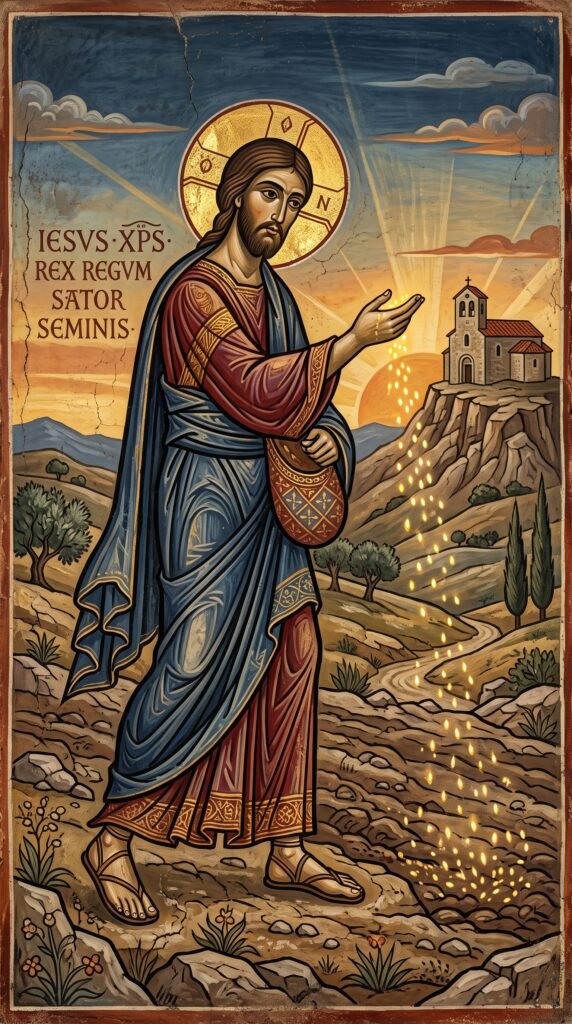
Notice, first of all, how this farmer sows. No farmer in Galilee — no farmer anywhere — would waste precious seed on a footpath, on rocky shelves of limestone barely covered by soil, on ground already infested with thorns. Seed was costly. A prudent sower would target only the good soil.
But this Sower is not prudent. He is prodigal. He throws seed everywhere, on every kind of ground, as if He could not help Himself, as if His very nature were to give without calculating the return. The Fathers of the Church saw in this detail the whole character of God: Saint John Chrysostom marvels that the Sower “makes no distinction in the land, but simply and indifferently casts his seed.” This is the same God who makes His sun rise on the evil and the good, and sends rain on the just and the unjust (Mt 5:45). Grace is not rationed. It is poured out.
And this is where the first reading illuminates the Gospel from within. Isaiah, speaking to a people broken by exile — a people tempted to believe that God’s promises had failed — delivers one of the most consoling oracles in all of Scripture: “Just as from the heavens the rain and snow come down and do not return there till they have watered the earth… so shall my word be that goes forth from my mouth; it shall not return to me empty, but shall do what pleases me, achieving the end for which I sent it” (Is 55:10–11).
The Word of God carries within itself a divine efficacy. It is not information; it is power. It is not a suggestion; it is an event. In the Hebrew mind, dabar — word — is not merely something spoken but something that happens. When God speaks, reality changes: “Let there be light,” and there was light. The Church has always confessed that this Word reached its fullness when it did not merely descend like rain but took flesh and dwelt among us. Jesus Christ is Himself the Word that does not return empty; He returned to the Father having accomplished everything — “It is finished” (Jn 19:30) — and He returned not empty-handed, but carrying redeemed humanity with Him.
II. The mystery of freedom
But here the scandal returns. If the Word is that powerful, if the seed is always good, why do so many hearts remain unchanged? Why do two people kneel at the same Mass, hear the same Gospel, receive the same Lord — and one is slowly transfigured while the other walks out untouched?
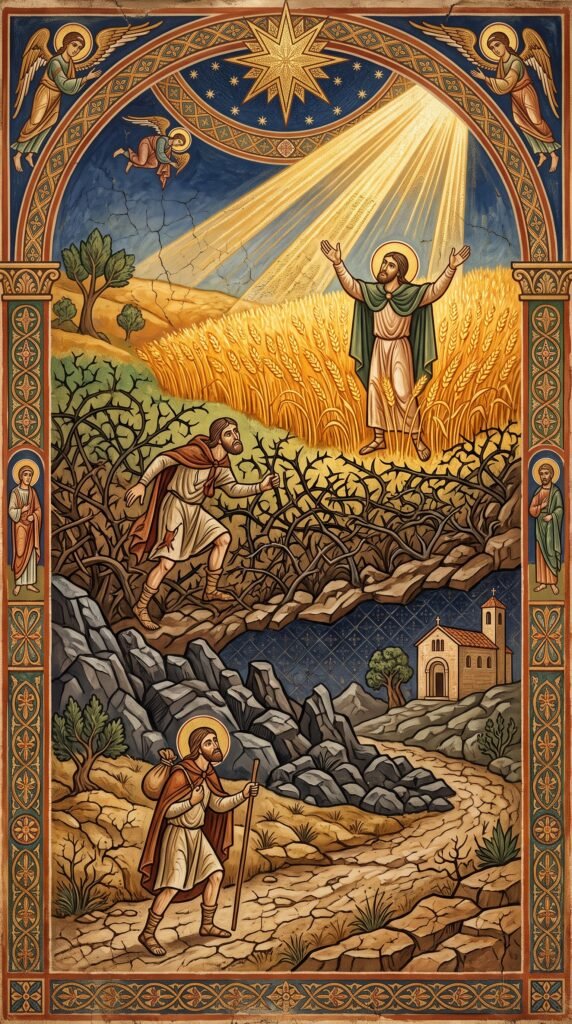
Jesus answers with the four soils, and His answer preserves something God refuses to violate: our freedom. The all-powerful Word becomes, in a sense, vulnerable at the threshold of the human heart. Saint Augustine put it unforgettably: “God who created you without you will not save you without you.” Omnipotence stops, reverently, at the door of human consent — because love that is forced is not love at all. God proposes; He never imposes. This is why Jesus teaches in parables: a parable does not coerce the mind the way a syllogism does. It invites. It leaves room. It can be walked away from. “Whoever has ears ought to hear” — the parable respects the freedom of the listener even as it pursues him.
And so the four soils are not four categories of people, as if some were fated to be pathways and others fated to be fertile. They are four conditions of every human heart — often all four in a single week, sometimes in a single day.
The path is the heart hardened by traffic — the heart so trampled by noise, opinions, scrolling, and hurry that the Word cannot even penetrate the surface before the evil one snatches it away. Chrysostom observes that the birds are not the real problem; the real problem is the hardness that left the seed exposed.
The rocky ground is the heart of enthusiasm without depth — the faith of consolations, alive as long as God feels close and prayer feels sweet, but collapsing at the first trial “because it had no root.” How much contemporary faith is precisely this: emotionally vivid, theologically shallow, gone by the first serious suffering.
The thorns are perhaps the most dangerous soil, because here the seed actually grows — and is strangled slowly. Jesus names the thorns with clinical precision: “worldly anxiety and the lure of riches.” Not scandalous sins. Ordinary preoccupations. The mortgage, the calendar, the need to control outcomes, the quiet worship of security. Thorns do not attack the faith; they simply crowd it out, until Christ is still present in the heart but no longer has room to bear fruit.
And then there is the good soil. Notice that Jesus does not describe it as perfect soil. Good soil is simply soil that has been broken open — plowed, humbled, made receptive. In the spiritual life, the plow is often suffering, repentance, honest self-knowledge. The Greek of Luke’s parallel says this heart holds the word “with patient endurance” (Lk 8:15). The good soil is not the sinless heart; it is the humble heart that keeps receiving, keeps persevering, keeps rising after every fall.
III. Creation on tiptoe
And what happens when the Word finally finds such a heart? Saint Paul lifts our eyes to a horizon so vast it takes the breath away: “Creation awaits with eager expectation the revelation of the children of God… in hope that creation itself would be set free from slavery to corruption” (Rom 8:19–21).
The Greek word Paul uses — apokaradokia — paints the picture of someone craning the neck, standing on tiptoe, straining to see what is coming. Paul dares to say that the entire cosmos is doing this: all of creation, groaning as in labor pains, is waiting — for us. Waiting for men and women in whom the seed of the Word has actually borne fruit. The redemption of the world, in Paul’s vision, passes through the transformation of human hearts. When grace conquers a single soul, something begins to heal in the fabric of the universe itself.
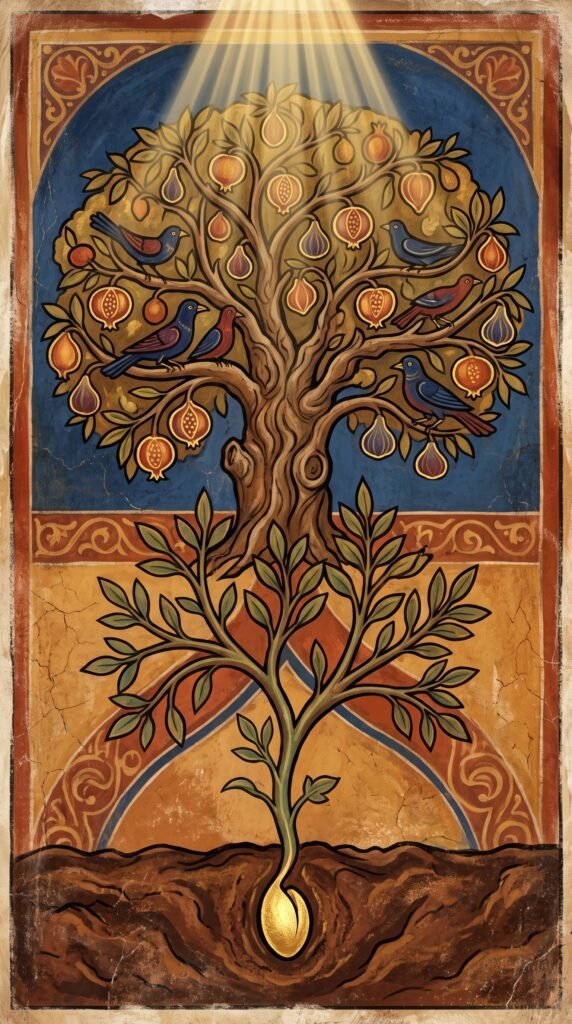
This means your interior life is not a private affair. The soil of your heart has cosmic consequences. Every saint is a piece of creation set free. And conversely, every heart that remains a footpath is a field the world is still waiting on.
IV. The hundredfold
Let me end where Jesus ends: with the yield. “A hundred or sixty or thirtyfold.” A Galilean farmer rejoiced over a sevenfold or tenfold harvest. A hundredfold was not a good harvest; it was a miracle — the abundance of the messianic age breaking into ordinary ground. Jesus is telling us that when the Word finally takes root in a free and humble heart, the result is not modest improvement. It is disproportionate, unreasonable fruitfulness. Twelve fishermen. One Word. And here we are, twenty centuries later, on another continent, in another language, still harvesting.
In a few moments, the Sower will go out to sow again — not from a boat by the Sea of Galilee, but from this altar. The same Word will be proclaimed; the same Christ, the grain of wheat that fell into the earth and died, will be placed into your hands. The seed, as always, will be good. The seed will be perfect.
The only question this Sunday asks — the only question it has ever asked — is the one each of us must answer in the silence of our own soul:
What kind of soil will He find in me today?
Amen.